





















Trump Planning New Superclub With India? All About the Buzz on the New Core-5 Grouping
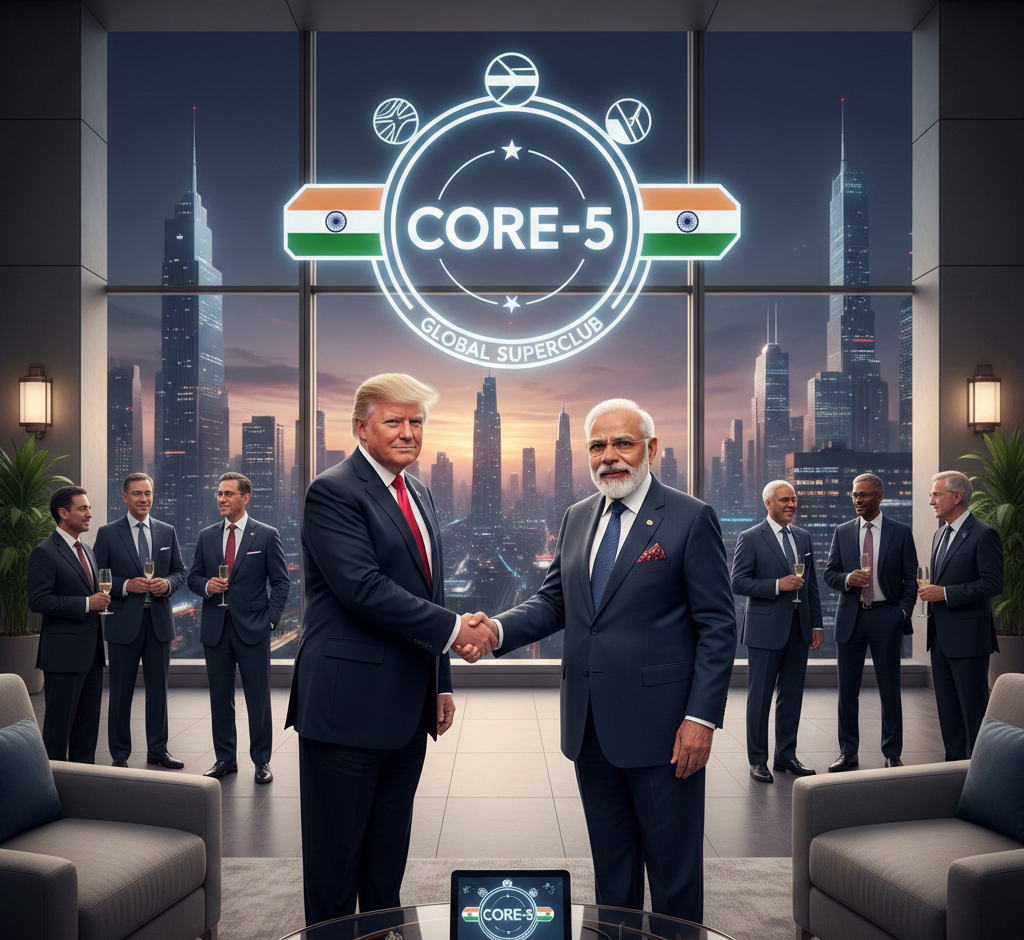
A new geopolitical buzz has emerged around former U.S. President Donald Trump and an alleged proposal to create a powerful global grouping known as the “Core-5” or “C5”. While not officially announced or confirmed by any government, the idea has stirred debates in diplomatic, strategic, and media circles. The concept, if true, could reshape the global balance of power by bringing together five of the world’s most influential nations — including India.
What Is the Core-5 or C5?
According to the discussions circulating in policy circles, the Core-5 is envisioned as a strategic club consisting of:
United States
India
China
Russia
Japan
Unlike existing international groups such as the G7, which are based on economic strength and democratic values, the Core-5 would be built around population size, global influence, and geopolitical weight. It would bring together both Western and non-Western powers, rivals and partners, democracies and authoritarian states — an unusual mix unlikely in today’s divided international environment.
Where Did the Buzz Begin?
The speculation reportedly emerged from claims that an unpublished or extended version of the U.S. National Security Strategy mentioned the idea of regular Core-5 meetings. These meetings would supposedly focus on issues like Middle East stability, energy security, and efforts to normalize relations between Israel and Saudi Arabia.
However, U.S. officials have denied the existence of any such “secret” version of the strategy document. This has added to the mystery — raising questions about whether the idea was merely exploratory thinking within policy networks or a leaked draft that was never meant to go public.
Why Would Trump Want a New Superclub?
If the concept originated during Trump-era strategic thinking, it fits several patterns of his foreign policy approach:
1. Reducing dependence on traditional Western alliances
Trump has often criticized NATO and the G7 for being ineffective or outdated. A new club centred around major global powers would reflect his preference for power-based rather than values-based alliances.
2. Attempt to re-engage China and Russia
Bringing the U.S., China, and Russia into the same forum could be seen as an effort to manage great-power rivalry through direct, exclusive engagement rather than multilateral institutions dominated by Europe.
3. Acknowledging India’s growing role
India’s rising global influence, demographic power, and strategic independence make it central to any future power architecture. A Core-5 grouping places India at the table of the world’s most consequential states.
Why India Is Important in the C5 Idea
India remains both a strategic partner of the U.S. and a rival competitor to China. Its relationships with Russia and Japan also span military, energy, and technology sectors. Any grouping that includes both China and the U.S. would require a stable, balancing power — a role India increasingly occupies.
The idea of India joining such a grouping signals global acknowledgment of:
Its status as a major economy
Its military reach
Its pivotal role in the Indo-Pacific
Its diplomatic ability to engage with multiple power blocs
Why Europe Is Worried
Some European analysts view the Core-5 concept as a potential marginalization of Europe, especially in comparison to the G7, where Europe holds multiple seats. A new grouping without the UK, France, Germany, or the EU could shift the centre of global decision-making away from the Atlantic and toward a more multipolar arrangement dominated by Asia.
Is the Core-5 Becoming Reality?
As of now:
No meeting has been held.
No country has confirmed participation.
No framework, charter, or timeline exists.
The proposal remains informal, unverified, and speculative.
Still, the fact that such an idea is being discussed at all reflects a shifting geopolitical landscape — one where old alliances may no longer fully serve the interests of rising or re-emerging powers.
Conclusion
The idea of Donald Trump planning a new “superclub” with India and other major nations has captured global attention, even though it remains unconfirmed. The Core-5, if ever formed, would mark a significant evolution in global governance, bringing together five power centres that shape modern geopolitics.
For India, the buzz itself highlights its growing international stature. For the world, it raises questions about whether the future will be multipolar, power-centric, and dominated by a few states — or continue to rely on established institutions like the G7 and NATO.