























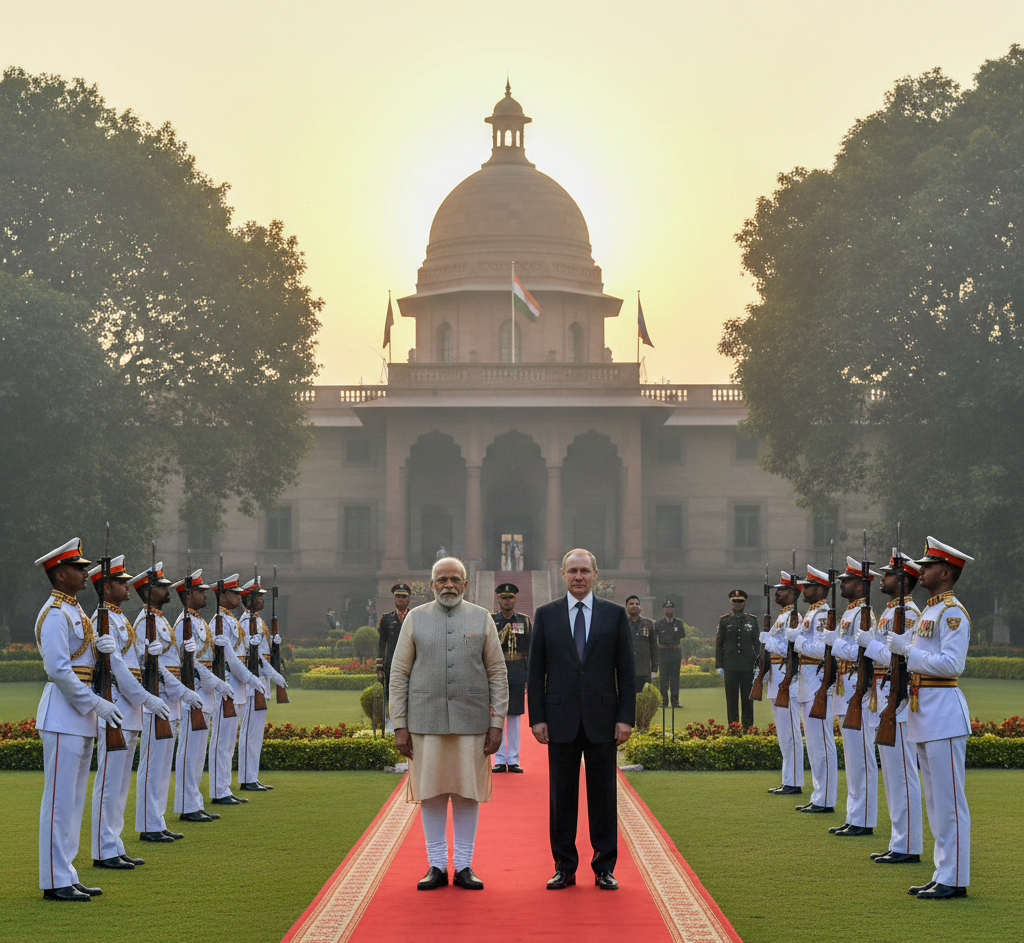
What Happened — Step-by-Step on 5 December 2025
On the morning of 5 December 2025, President Putin was given a full ceremonial welcome and guard of honour at Rashtrapati Bhavan, marking the formal start of his state visit to India.
He then visited Rajghat in New Delhi to pay his respects by laying a wreath, honouring the memory of Mahatma Gandhi — a symbolic gesture reflecting respect for India’s past and values.
Later, Putin arrived at Hyderabad House to meet Prime Minister Modi. There, the two leaders held high-level bilateral talks as part of the 23rd India-Russia Annual Summit, discussing areas including defence, trade, energy, and strategic cooperation.
🗣️ What Leaders Said — Key Takeaways from Their Meeting
At the joint press briefing following their meeting, PM Modi said that “trust is our greatest strength,” reiterating that India remains “on the side of peace.”
Putin described the India-Russia partnership as “deeply rooted in history” and spoke of opportunities to expand cooperation in technology, defence, energy, and other strategic sectors.
The summit is expected to result in a series of agreements aimed at boosting bilateral trade and defence ties — signifying India and Russia’s intent to deepen strategic engagement in 2025.
🔎 Why the Guard of Honour + Rajghat Visit Matters — Symbolism & Diplomacy
The guard of honour at Rashtrapati Bhavan is more than protocol — it’s a strong diplomatic signal: by extending full ceremonial welcome to Putin, India underscores that despite global pressures, it values its long-standing ties with Russia.
The homage at Rajghat is symbolic: it shows that Russia’s leader respects India’s founding ideals and honours national icons — a gesture that resonates well domestically and internationally.
Meeting at Hyderabad House — the traditional venue for high-level bilateral talks — reinforces that this isn’t just a photo-op, but a substantive summit, with serious discussions on future cooperation across multiple sectors.
🌐 What This Means for India-Russia Relations in 2025
The warmth, protocol and symbolism reflect that India continues to view its relationship with Russia as a “privileged strategic partnership,” even in a complex global scenario.
The focus on defence, energy, trade and technology suggests both countries aim to deepen cooperation in critical areas for years ahead.
The timing — Putin’s first visit since 2021, after global upheavals including the Ukraine war — shows that despite international pressure, India values strategic autonomy.
✨ Broader Significance — For Diplomacy, Geopolitics & India’s Global Position
The gracious reception and cordial tone send a message to global stakeholders: India remains open to strategic partnerships beyond traditional alliances.
Reinforcing ties with Russia, especially in defence and energy, offers India more leverage and options in global diplomacy, particularly amid shifting geopolitical tensions.
The 2025 summit can set the tone for future cooperation — not just bilateral deals, but collaboration in emerging sectors like technology, energy, and strategic supply chains.
✅ Conclusion — A High-Stakes, High-Symbolism Summit
The 2025 meeting of Modi and Putin — marked by ceremonial honours, a tribute at Rajghat, and substantive talks at Hyderabad House — wasn’t just another diplomatic event. It was a carefully choreographed reaffirmation of ties, trust, and strategic alignment. At a time when global power dynamics are shifting, this summit re-affirmed that the India–Russia partnership remains a key pillar of India’s foreign policy.