


































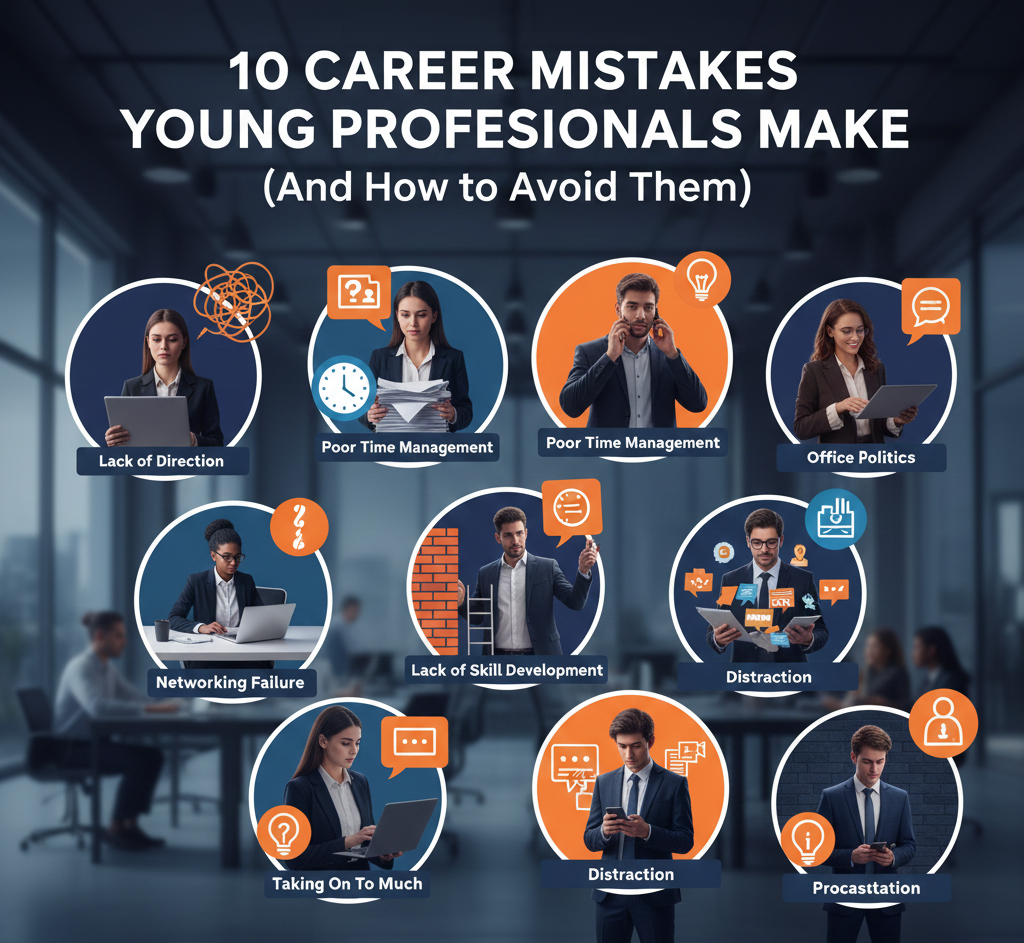
10 Career Mistakes Young Professionals Make (And How to Avoid Them)
Starting your career is like entering a maze — exciting, confusing, and full of wrong turns. Below I expand each mistake with real signs to watch for, why it matters, and practical, bite-sized actions you can take today to avoid the trap and accelerate your growth.

❌ Mistake 1: Waiting for the “Perfect Job”
What people think: There’s one ideal role that will solve everything.
Why it’s wrong: Waiting wastes time and blocks you from learning. Real experience — even if imperfect — teaches skills employers actually value.
Signs you’re doing this
You only apply to “dream” roles and ignore junior openings.
You reject offers because they’re “not the right fit yet.”
You stay unemployed for long while holding out.
How to avoid it — actions
Apply to 3 “stretch” roles + 3 realistic roles each week.
Treat your first jobs as experiments: set 3 learning goals for the next 6 months.
Take short-term contracts or freelance gigs to build experience quickly.
Quick exercise: List 5 transferable skills you can gain in any job (e.g., communication, time management, stakeholder handling) and pick jobs that offer at least 2.
❌ Mistake 2: Not Learning New Skills
What people think: My degree is enough.
Why it’s wrong: Tech and workflows change fast — stagnation equals obsolescence.
Signs
You haven’t taken a course or read industry news in 6+ months.
You avoid tasks that involve new tools or data.
How to avoid it — actions
Adopt the 1% rule: learn 1 small thing every day (a tutorial, article, short course).
Use platforms like Coursera/edX/YouTube for targeted learning. (Pick one module, finish it within 2 weeks.)
Build tiny projects to apply skills — a real demo matters more than certificates.
Monthly checklist: Complete one micro-course + build a 1-page portfolio/example.
❌ Mistake 3: Thinking a Degree Guarantees a Job
What people think: Diploma = lifelong security.
Why it’s wrong: Employers hire capability, not paper. Soft skills and demonstrable outcomes beat a degree alone.
Signs
You don’t prepare for interviews beyond academic talking points.
Your LinkedIn has no projects, only qualifications.
How to avoid it — actions
Create a one-page portfolio: projects, results, tools used.
Practice behavioral interview stories: problem → action → result.
Volunteer for cross-functional projects that show initiative.
Template STAR story: Situation, Task, Action, Result — write 3 ready-to-tell stories.
❌ Mistake 4: Ignoring Networking
What people think: Networking is fake or only for job hunters.
Why it’s wrong: Most roles are influenced by relationships. Networking = knowledge, mentors, opportunities.
Signs
You never reach out to people in your industry.
You only network when desperate.
How to avoid it — actions
Build a weekly habit: connect with 2 new people and engage with 3 industry posts.
Use simple outreach templates (see below).
Offer value first: share an article, introduce two contacts, ask a focused question.
Outreach template (DM/email):
“Hi [Name], I loved your recent post on [topic]. I’m a [role/aspiring role] and curious how you handled [specific challenge]. Could I ask one quick question? — [Your name]”
❌ Mistake 5: Staying in a Toxic Workplace
What people think: Endure now, succeed later.
Why it’s wrong: Toxic environments drain skills, confidence, and health.
Signs
Chronic stress, unanswered concerns, bullying, unethical behavior.
Your performance and sleep are worsening.
How to avoid it — actions
Set boundaries: specific work hours, no after-hours email unless urgent.
Document incidents and seek HR or mentor advice.
Plan an exit strategy: update resume, save 3 months’ expenses, and apply discreetly.
If you must stay temporarily: Limit exposure, take on visible projects that build your CV, and network externally.
❌ Mistake 6: Not Asking Questions
What people think: Asking shows ignorance.
Why it’s wrong: Questions speed learning and prevent costly mistakes.
Signs
You complete tasks incorrectly rather than clarifying expectations.
You avoid meetings because you fear looking “green.”
How to avoid it — actions
Prepare 3 clarifying questions before each meeting.
Use the “teach-back” method: summarize your understanding and ask if it’s correct.
Frame questions as curiosity: “Help me understand how you chose X over Y.”
Quick practice: Ask one clarifying question per day at work.
❌ Mistake 7: Being Afraid of Failure
What people think: Failure equals incompetence.
Why it’s wrong: Failure is data — it shows what doesn’t work and points to what might.
Signs
You avoid high-growth projects with risk.
You only do safe tasks and complain about slow progress.
How to avoid it — actions
Run small experiments (time-boxed) and measure results.
Normalize post-mortems: what went well, what didn’t, what’s next.
Celebrate small failures — they’re learning milestones.
Mindset trick: Treat your career like A/B testing — test, learn, iterate.
❌ Mistake 8: Not Saving Money
What people think: I’ll save later when I earn more.
Why it’s wrong: Emergencies, job gaps, and opportunities require runway.
Signs
No emergency fund, living paycheck-to-paycheck.
Panic when unexpected costs arise.
How to avoid it — actions
Automate savings: 10–20% of salary to an emergency fund.
Use the 50/30/20 rule: 50% needs, 30% wants, 20% savings/debt.
Build a 3–6 months’ expense cushion before big risks (quitting, starting a biz).
Starter step: Set up an auto-transfer the day salary arrives.
❌ Mistake 9: Comparing Yourself With Friends
What people think: If they’re ahead, I’ve failed.
Why it’s wrong: Careers are non-linear — surface comparisons ignore context.
Signs
You constantly check peers’ promotions/posts and feel demotivated.
You copy someone else’s path instead of tailoring your strengths.
How to avoid it — actions
Maintain a personal progress log — wins, skills learned, feedback received.
Set 90-day goals based on your values, not peers.
Limit social media that triggers comparison.
Reflection prompt: What progress have I made in the last 6 months that no one else can take away?
❌ Mistake 10: Not Knowing When to Switch Jobs
What people think: Tenure is always good.
Why it’s wrong: Staying too long in a dead-end role stalls skills and salary growth.
Signs
You’re bored, underused, or passed over for promotions repeatedly.
Your role doesn’t enhance your resume for your next goal.
How to avoid it — actions
Use the “3 Cs” test every 12 months: Challenge, Compensation, Culture. If two are missing, start exploring.
Set a 6–12 month plan before leaving: skills to gain, contacts to build, finances to save.
Be strategic: aim for roles that advance you 12–24 months ahead, not lateral repeats.
Decision checklist: Are you learning? Are you growing? Is the pay market-aligned? If “no” to 2+, consider moving.
🎯 Final Thoughts & Action Plan (30-day starter)
Careers don’t follow a straight line. Avoid these mistakes by treating your career like a product you manage:
30-day action plan
Create a 1-page career map (skills, 90-day goals).
Apply to 6 roles (mix of stretch + realistic).
Complete one micro-course and build a mini-project.
Connect with 6 industry people and send 3 outreach messages.
Automate savings: move 10% of salary to emergency fund.
Small consistent moves beat big dramatic changes. Start now — your future self will thank you. 🚀