

































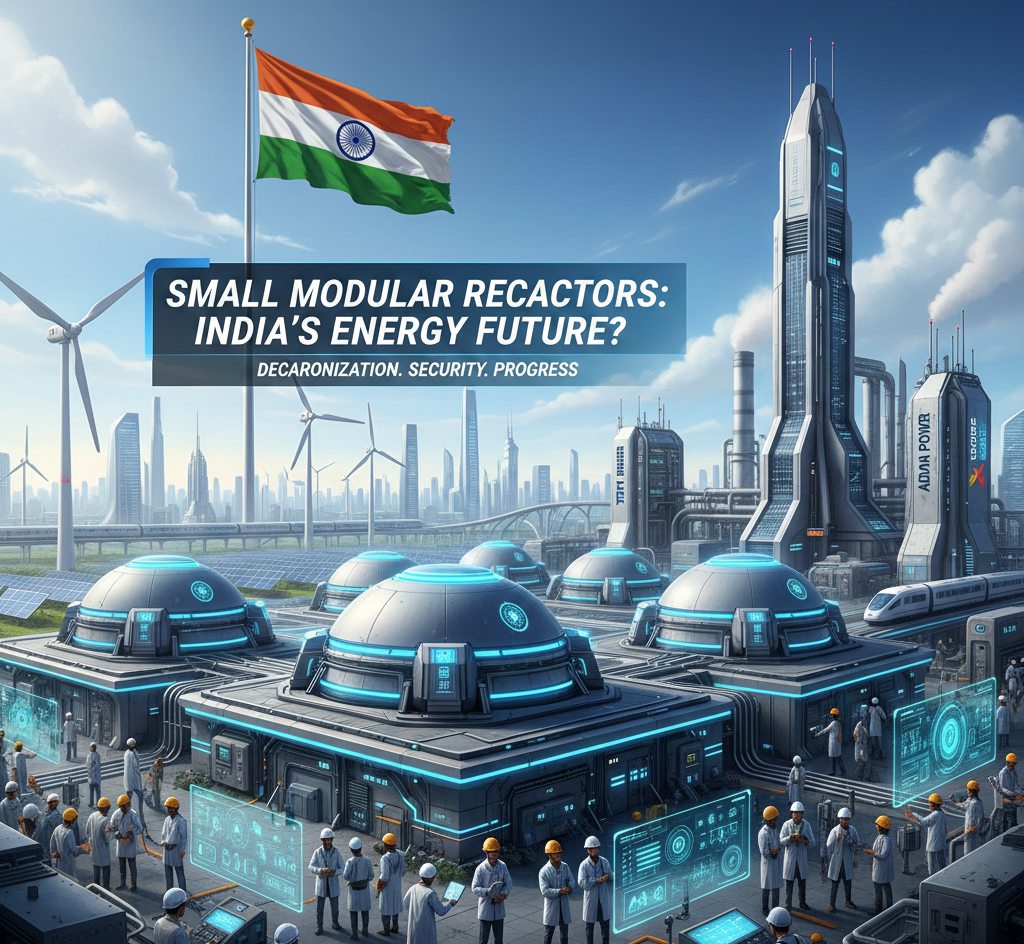
Are Small Modular Reactors the Future of Nuclear Energy for India in 2025?
In 2025, India is undergoing one of the most significant shifts in its nuclear-energy strategy in decades. As the country pursues rapid economic growth, rising electricity demand, and ambitious climate commitments, Small Modular Reactors (SMRs) have emerged as a promising new frontier. Policymakers, scientists, and industry leaders are positioning SMRs as a flexible, scalable, and cleaner alternative to traditional large nuclear plants.
But the question remains — are SMRs truly the future of nuclear energy for India?
What Makes SMRs Important in 2025?
SMRs are compact nuclear reactors that typically generate up to 300 MW of electricity. Unlike large nuclear installations, SMRs are designed to be:
Modular — most components can be manufactured in factories and transported to sites
Cost-effective — lower upfront investment than gigawatt-scale reactors
Flexible — suitable for remote regions, industrial clusters, and smaller grids
Faster to deploy — shorter construction timelines
Safer — enhanced passive safety systems and smaller core sizes
In 2025, India has formally adopted a policy push toward SMRs through:
A dedicated Nuclear Energy Mission
Government funding to accelerate SMR research, development, and indigenous manufacturing
Plans to establish multiple SMR models (200 MWe, 55 MWe, and high-temperature units for hydrogen production)
Proposals to reform nuclear laws to allow private sector participation
This marks a major shift from India’s historically state-dominated nuclear sector.
Why SMRs Could Transform India’s Energy Landscape
1. Meeting Rising Electricity Demand
India’s power consumption continues to surge in 2025 due to industrial expansion, urbanisation, and electrification. SMRs can complement renewables by providing stable, round-the-clock power.
2. Supports Clean-Energy Commitments
As India moves toward a lower-carbon future, nuclear energy offers a reliable, emissions-free source of baseload power. SMRs can strengthen the renewable-nuclear balance by reducing dependence on coal.
3. Ideal for Industrial and Remote Applications
Heavy industries such as steel, cement, aluminium, and chemicals require continuous power. SMRs can serve as captive power units for such sectors or bring reliable electricity to remote regions where building large reactors is impractical.
4. Hydrogen Production & Industrial Decarbonisation
High-temperature SMR designs can produce clean hydrogen, supporting the National Green Hydrogen Mission and helping decarbonize hard-to-abate industries.
5. Lower Financial and Construction Risks
Large nuclear projects often face delays and cost overruns. SMRs offer a modular approach that reduces risk through standardization, factory fabrication, and shorter build times.
Challenges and Uncertainties Ahead
While promising, SMRs are not without hurdles:
1. Technology Maturity
SMRs are still emerging globally. Few commercial units exist today, and most are in pilot or testing stages. India must close gaps in supply chains, testing facilities, and regulatory frameworks.
2. Economic Viability
SMRs become cost-competitive only when manufactured at scale. Until the ecosystem matures, per-unit costs may remain high.
3. Regulatory and Safety Frameworks
Adapting India’s nuclear regulations to accommodate new reactor types, private participation, and modular construction will be crucial.
4. Public Acceptance
Nuclear power often faces skepticism in India due to safety concerns. Effective communication and transparency will be essential for public trust.
5. Dependence on Global Technology
While India is developing indigenous SMRs, collaboration with foreign partners may be necessary for advanced designs, raising geopolitical and supply-chain considerations.
Do SMRs Secure India’s Nuclear Future?
India’s goal of expanding nuclear capacity significantly by 2047 aligns well with what SMRs can offer. In the 2030s, India is likely to see:
Operational indigenous SMR units
Increased private participation
SMRs supporting industrial decarbonisation
Hybrid energy systems combining SMRs, hydrogen, solar, and storage
Replacement of old coal plants with modern nuclear small-reactor clusters
SMRs will not replace large reactors entirely, but they can complement them, offering flexibility, scalability, and regional adaptability.
Conclusion: A Major Pillar — Not the Whole Structure
In 2025, Small Modular Reactors are among the most promising technologies in India’s nuclear-energy roadmap. They align well with India’s energy needs, industrial growth, climate goals, and the push toward clean technologies.
However, the future of SMRs will depend on:
Successful demonstration projects
Scaling manufacturing
Regulatory reforms
Public acceptance
Strong coordination between government, industry, and research institutions
SMRs are poised to become a major pillar of India’s future energy infrastructure — but they will work best as part of a balanced mix that includes renewables, large nuclear reactors, and clean fuels like hydrogen.