















“We Expected Him to Lead”: CPM MP Critiques Rahul Gandhi’s Germany Trip
In a recent turn of events that has stirred political debate in India, a senior Communist Party of India (Marxist) leader openly criticized Congress leader Rahul Gandhi for his decision to travel to Germany during a crucial period of Parliament’s Winter Session. The comments from the CPM lawmaker have raised eyebrows and prompted widespread discussion about leadership priorities, opposition coordination, and the optics of international trips by senior politicians.
The controversy began when Rahul Gandhi chose to travel to Germany for an event organized by the Indian Overseas Congress, a wing of the party that engages with non-resident Indians. The trip, scheduled from December 15 to 20, coincided with the final stretch of Parliament’s Winter Session — a period during which key debates and legislative discussions were taking place. The absence of the Leader of the Opposition from Parliament at such a critical juncture drew sharp criticism from both allies and political observers.
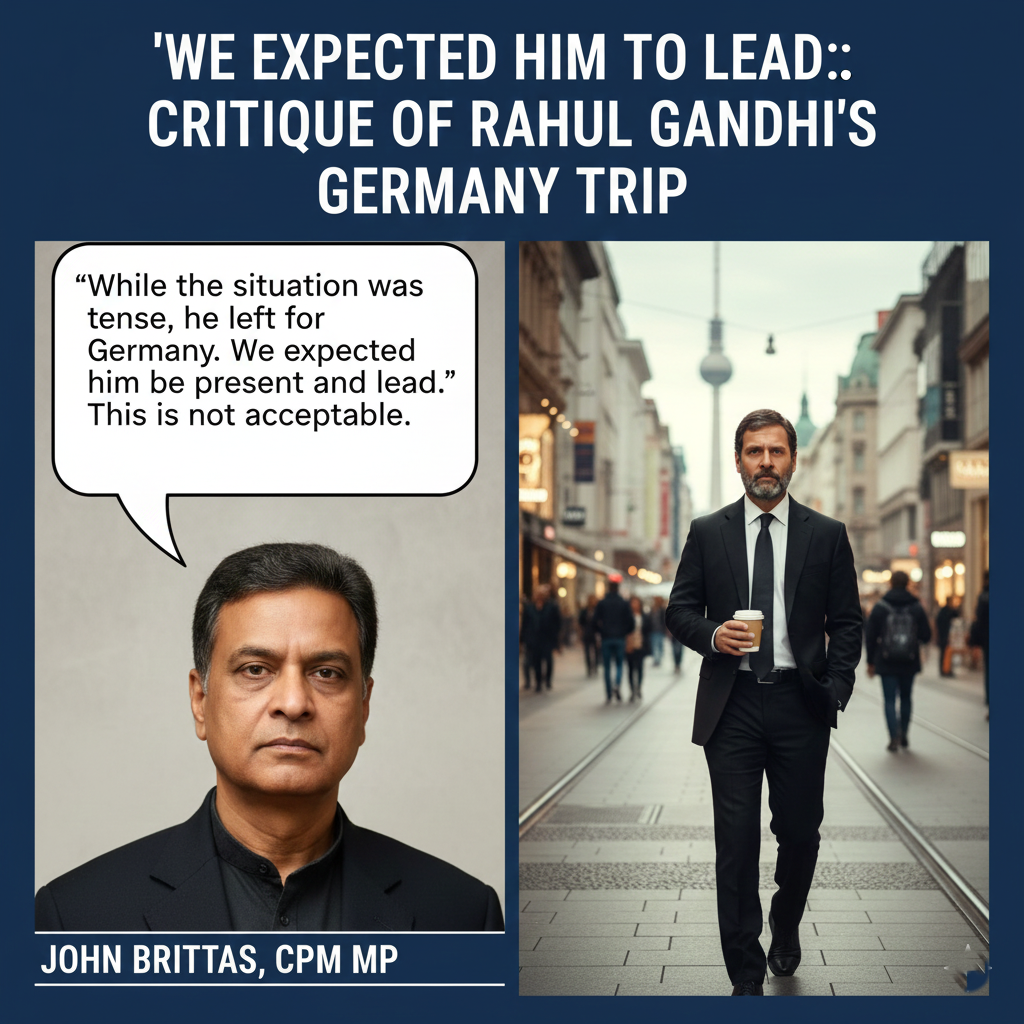
CPM MP John Brittas, a prominent voice within the opposition, publicly stated that he and other members had “expected the Leader of the Opposition to lead” during the session. He emphasized that Rahul Gandhi’s presence in the Lok Sabha could have had a meaningful impact on parliamentary proceedings, particularly in debates on contentious legislation. Brittas suggested that Gandhi’s decision to travel abroad at such a critical time sent the wrong signal about the opposition’s seriousness and commitment to parliamentary responsibility.
Brittas also expressed concern over the wider political message conveyed by Gandhi’s trip, pointing out that even ceremonial engagements by other Congress leaders, such as Priyanka Gandhi Vadra, did not compensate for the absence of the opposition’s central figure. According to him, attending events abroad while the nation’s legislative business was ongoing could undermine the opposition’s credibility and strategy.
The Congress leadership, however, defended the timing of the Germany visit. Party sources highlighted the importance of engaging with the Indian diaspora and participating in international forums, arguing that such interactions are crucial for maintaining India’s presence on the global stage. They also noted that invitations to foreign events often come with fixed schedules, requiring careful balancing between domestic political duties and international commitments.
Despite these defenses, the CPM MP’s critique underscores tensions within the opposition. While allies officially support the Congress-led coalition, voices like Brittas’s indicate that there is unease regarding leadership choices at pivotal moments. The criticism also comes in the backdrop of ongoing political rivalries with the ruling Bharatiya Janata Party (BJP), which has seized on the trip to question Gandhi’s commitment to domestic responsibilities. BJP leaders have characterized the Germany visit as neglect of parliamentary duties and framed Gandhi’s overseas engagements as evidence of misplaced priorities.
Political analysts suggest that the episode highlights the challenges faced by opposition leaders in balancing legislative responsibilities, international diplomacy, and party strategy. The timing of Gandhi’s trip, coinciding with intense parliamentary debate, has amplified scrutiny, particularly from allies who expect decisive leadership during high-stakes political moments. The CPM MP’s public comments indicate that there is concern not only about Gandhi’s personal choices but also about the cohesion and effectiveness of the opposition bloc as a whole.
The Germany trip has also sparked discussion on the optics of political leadership. In an era where media scrutiny and social media commentary shape public perception, even well-intentioned actions can be interpreted as neglect or misjudgment. Critics argue that the absence of the opposition leader during a critical parliamentary session can be seen as a symbolic weakening of resistance to government initiatives, while supporters contend that global engagement is equally vital for the country’s long-term interests.
Ultimately, the CPM MP’s critique reflects broader questions about leadership and priorities within India’s opposition. Rahul Gandhi’s Germany trip has become more than just a personal or ceremonial visit; it has highlighted the delicate balance that political leaders must maintain between domestic responsibilities and international representation. Allies, critics, and the public alike are closely watching how such decisions affect the opposition’s unity, credibility, and ability to present a coherent front in India’s complex political landscape.
The incident serves as a reminder that leadership is often judged not just by intent but by timing and perception. As the Winter Session concluded and discussions around the trip continue, the broader debate is likely to focus on whether international engagements can coexist with active, hands-on parliamentary leadership — or whether such absences create opportunities for criticism and erode confidence among allies and constituents alike. For now, the CPM MP’s statement stands as a clear indication that even within opposition ranks, expectations of leadership remain high, and deviations from those expectations are likely to attract scrutiny and debate.