





























Anti-India Leader Behind ‘Greater Bangladesh’ Map Dies, Dhaka On Edge
Dhaka, Bangladesh – December 19, 2025: Bangladesh was thrown into turmoil following the death of Sharif Osman Hadi, the controversial leader behind the so-called “Greater Bangladesh” map and a prominent figure known for his strong anti-India rhetoric. Hadi, aged 42, passed away in a Singapore hospital on December 18, 2025, after being critically injured in a shooting in Dhaka on December 12, 2025.
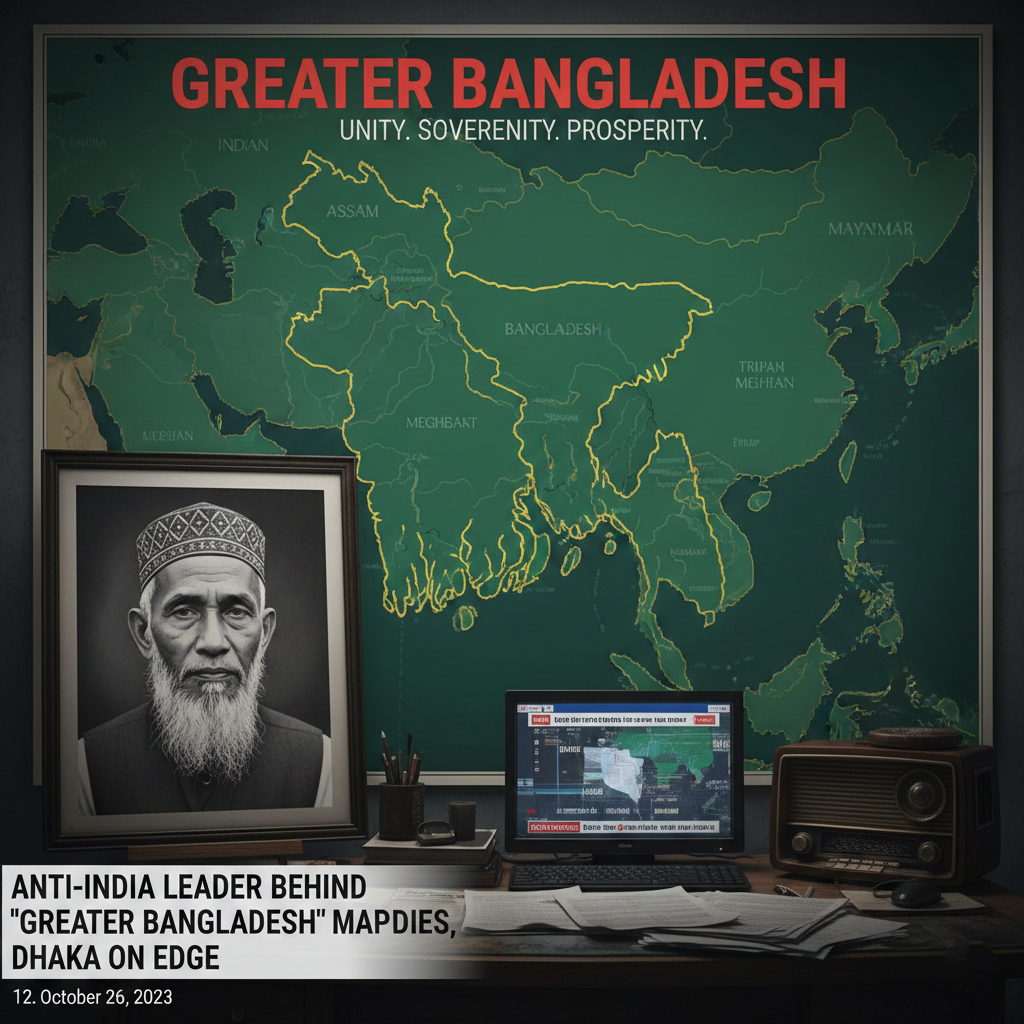
Hadi, a key leader of the radical Inquilab Mancha movement, had gained notoriety in Bangladesh and India for circulating maps that included large parts of Indian territory, which he claimed should be part of Bangladesh. His political stance, deeply rooted in anti-India ideology, often provoked tension between communities and authorities. Analysts in 2025 note that his death has heightened political polarization in Bangladesh at a time when the country is approaching its national elections in early 2026.
The incident that led to Hadi’s death began when unidentified assailants opened fire on him while he was campaigning in the heart of Dhaka. He sustained severe head injuries and was immediately rushed to Dhaka’s top medical facilities. Due to the critical nature of his condition, he was transferred to Singapore for advanced treatment. Despite the medical intervention, Hadi succumbed to his injuries, igniting nationwide protests.
Nationwide Unrest and Violence
Following the announcement of Hadi’s death, cities across Bangladesh erupted in violent demonstrations. Thousands of supporters took to the streets, demanding justice for their leader. Dhaka, Chittagong, Sylhet, and other major cities witnessed widespread unrest. Reports from 2025 indicate that media offices, including prominent newspapers, were vandalized and set on fire by angry mobs. Journalists were trapped in several buildings before being rescued, highlighting the volatile security situation in urban centers.
In addition to property damage, communal tensions flared. A tragic incident in Mymensingh saw the lynching and burning of a Hindu man amid the protests. This sparked further condemnation from civil society and underscored concerns about minority safety during periods of political unrest.
Government Response
The Bangladesh government, under the interim leadership of Chief Adviser Muhammad Yunus, acted swiftly to contain the crisis. Authorities launched a nationwide manhunt to apprehend the shooters responsible for the attack on Hadi. High alert security measures were imposed, and additional personnel were deployed to sensitive areas to prevent further escalation. The government declared national mourning and ordered flags to be flown at half-mast in memory of Hadi.
Officials emphasized that law enforcement would ensure justice while also protecting civilians and media personnel from harm. Border security along the India-Bangladesh frontier was reinforced amid fears that external actors could exploit the unrest.
Political and Diplomatic Implications
Hadi’s death has significant political implications in 2025. With Bangladesh approaching national elections, the situation has exposed deep divisions within the political landscape. Analysts suggest that radical movements, like Hadi’s Inquilab Mancha, continue to wield influence among young voters, potentially affecting election outcomes.
The death of Hadi also has diplomatic repercussions. While India has consistently rejected allegations of interference in Bangladesh’s internal affairs, Hadi’s anti-India campaigns had strained relations in the past. Observers in 2025 warn that political instability in Dhaka could complicate bilateral ties, particularly in border management and regional security cooperation.
The Legacy of Sharif Osman Hadi
Sharif Osman Hadi’s life and political career remain controversial. For supporters, he was a champion of nationalist pride and regional identity, while critics view him as a radical figure who exacerbated tensions between communities and countries. The circulation of the “Greater Bangladesh” map and his staunch anti-India positions continue to be cited in academic and policy discussions about South Asian geopolitics in 2025.
Experts predict that the aftermath of Hadi’s death could reshape political activism in Bangladesh. There is concern that factions within his movement may radicalize further, leading to more street protests and potential clashes in urban centers. Authorities are focusing on preventing escalation and maintaining order as the country prepares for its 2026 elections.
Conclusion
The death of Sharif Osman Hadi marks a turning point in Bangladesh’s political landscape in 2025. While his passing has ignited protests and unrest, it also raises questions about the future of radical movements, communal harmony, and Bangladesh-India relations. As the government works to restore order, citizens and policymakers alike are closely watching how the country navigates the twin challenges of political stability and social cohesion in the coming months.