



























How Dhurandhar Recreated Karachi’s Lyari on a 6-Acre Plot, 6,000 Km Away in Bangkok
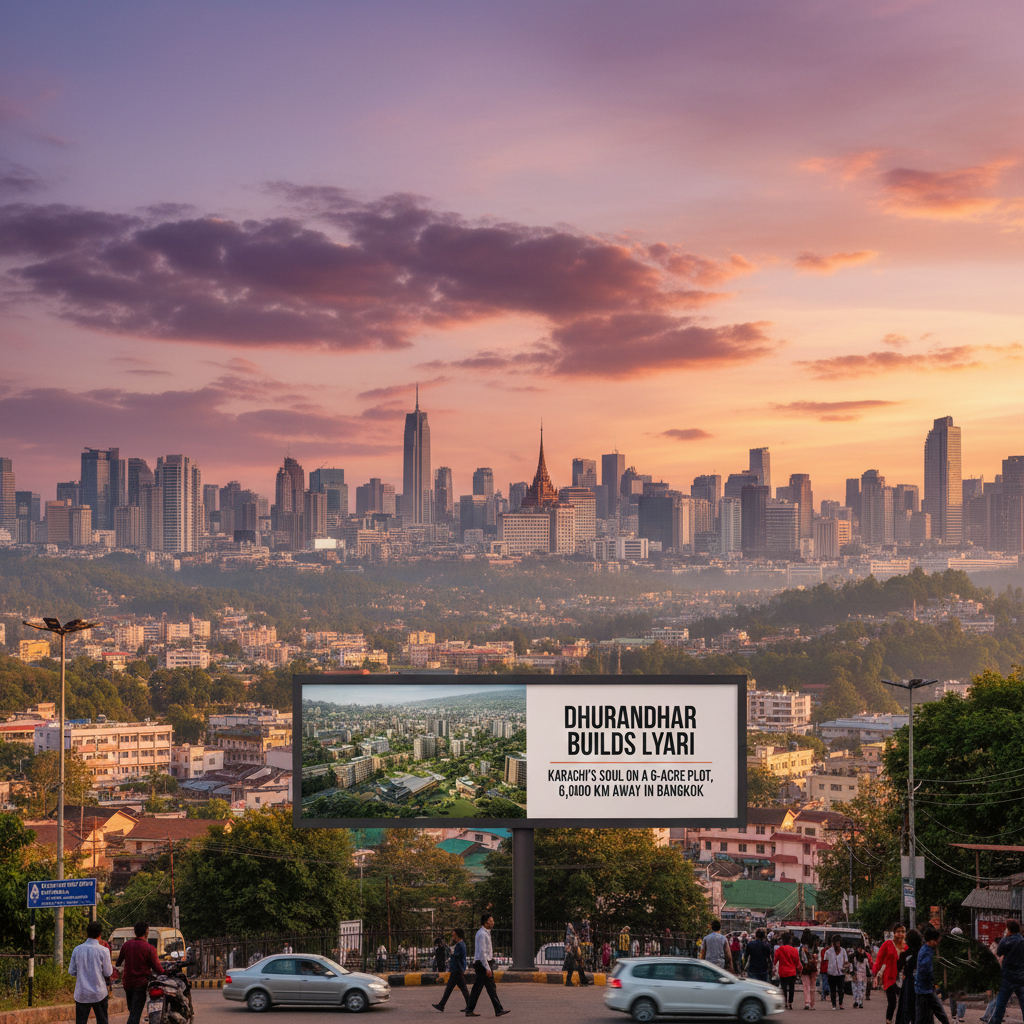
One of the most talked-about aspects of Dhurandhar is not just its performances or gripping narrative, but the astonishing realism of its setting. Few viewers realise that the gritty streets of Karachi’s Lyari shown in the film were not shot in Pakistan at all. Instead, the production team painstakingly recreated the neighbourhood on a sprawling six-acre plot in Bangkok, nearly 6,000 kilometres away.
The ambitious recreation stands as a testament to the scale, research, and craftsmanship behind the film, transforming an empty plot of land into one of South Asia’s most complex and storied urban landscapes.
Why Lyari Was Central to the Story
Lyari, often described as one of Karachi’s oldest and most culturally layered neighbourhoods, holds deep narrative importance in Dhurandhar. The area’s dense lanes, weathered buildings, balconies, street life, and raw energy were essential to the film’s atmosphere.
However, logistical and political challenges made shooting in the actual location impractical. Rather than compromise on authenticity, the filmmakers opted for a bold alternative — building Lyari from scratch.
Choosing Bangkok as the Base
Bangkok was selected due to its well-developed film infrastructure, availability of skilled crews, and supportive production environment. The city also offered large open spaces suitable for long-term set construction, something difficult to secure in many South Asian cities.
Once the location was finalised, the art and production design teams began months of groundwork, gathering visual references, architectural details, and cultural nuances of Lyari.
Building a City From the Ground Up
The six-acre plot was transformed into a detailed replica of Lyari’s streetscape. Narrow alleyways, uneven roads, aging facades, crowded balconies, staircases, shops, and mosques were all recreated with obsessive precision.
Walls were deliberately weathered to reflect decades of wear, posters and graffiti were added to mirror local political and social realities, and even street wiring and drainage details were carefully placed to enhance realism.
Authenticity Beyond Architecture
What set the recreation apart was the attention to everyday life. Vendors’ carts, signboards in local dialects, hand-painted advertisements, and period-accurate vehicles filled the streets. The production team ensured that nothing felt artificially staged.
Hundreds of extras were cast and dressed to reflect Lyari’s diverse social fabric. Their movements, routines, and interactions were choreographed to give the impression of a living, breathing neighbourhood rather than a static film set.
Cultural Research and Sensitivity
The filmmakers reportedly consulted cultural researchers and individuals familiar with Lyari’s history to avoid stereotyping or oversimplification. Music, background sounds, and ambient noise were designed to match the rhythm of the locality.
This commitment to detail helped the film avoid the generic “slum set” aesthetic and instead present a layered, humanised portrayal of a historically significant area.
Technical Challenges and Scale
Constructing such a massive set came with challenges. The team had to account for monsoon weather, lighting consistency, and structural durability for extended shooting schedules.
Cinematographers worked closely with the art department to ensure camera movement could flow naturally through narrow lanes, allowing for long tracking shots that added depth and intensity to the film’s action sequences.
Why Not Use CGI?
While digital effects were used selectively, the filmmakers chose practical sets over CGI to maintain realism. Actors reportedly found it easier to immerse themselves emotionally within a tangible environment, enhancing the authenticity of performances.
The decision paid off, as audiences and critics alike praised the film’s visual texture and grounded world-building.
A New Benchmark in Production Design
Industry insiders have hailed Dhurandhar’s Lyari set as one of the most ambitious reconstructions in recent Indian cinema. The project demonstrated that with research, respect, and resources, filmmakers can recreate complex geographies without compromising on detail or cultural integrity.
Conclusion
By recreating Karachi’s Lyari on a six-acre plot in Bangkok, Dhurandhar pushed the boundaries of cinematic world-building. The effort went far beyond set construction — it was an act of cultural reconstruction that allowed the story to unfold in an environment as raw and intense as its characters.
The result is a visual experience that feels real, immersive, and deeply rooted, proving that sometimes, the most authentic places on screen are built thousands of kilometres away.