
























Why Anti-India Mob Attacked Bangladesh Media Houses and Mujibur Rahman’s House
Dhaka, Bangladesh – December 19, 2025: Bangladesh has been gripped by widespread unrest following the death of Sharif Osman Hadi, the controversial leader behind the so-called “Greater Bangladesh” map and a prominent figure in the country’s radical political scene. Alongside protests, an anti-India mob attacked major media houses and the ancestral home of Sheikh Mujibur Rahman, raising concerns about political instability and communal tensions in 2025.
Background: The Death of Sharif Osman Hadi
Hadi, a radical student leader associated with the Inquilab Mancha movement, was shot in Dhaka on December 12, 2025, by unidentified assailants during election campaigning. Known for his anti-India rhetoric and promotion of maps depicting parts of India as part of Bangladesh, Hadi’s ideology had made him a polarizing figure. He was flown to Singapore for medical treatment but succumbed to his injuries on December 18, 2025.
His death triggered immediate protests, as thousands of his supporters poured into streets in Dhaka, Chittagong, and other cities, demanding justice for their leader. Analysts in 2025 describe the protests as both a political and ideological response, reflecting tensions over Bangladesh’s relations with India and internal governance issues.
The Attacks on Media Houses
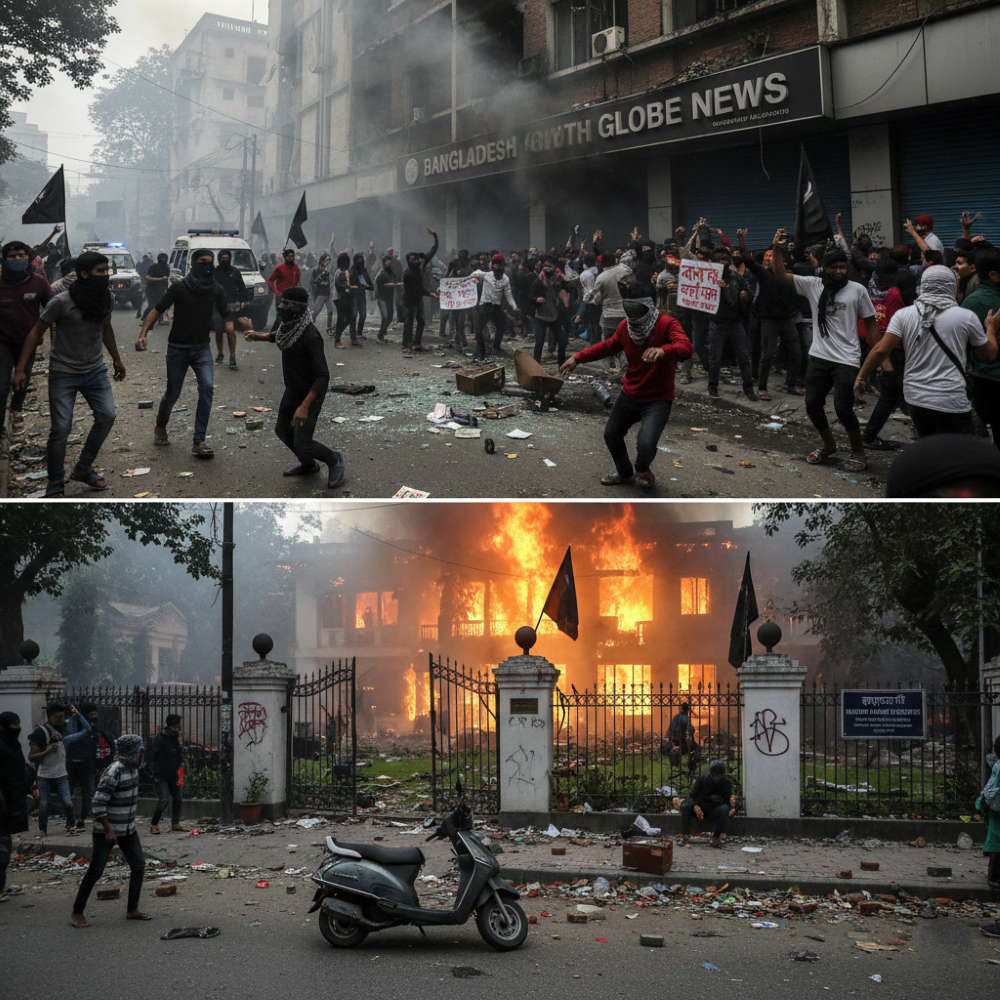
Amid the protests, the mob targeted major media offices, including the headquarters of leading newspapers. Angry crowds accused journalists of biased reporting against Hadi and alleged that the media had downplayed attacks on his supporters. In several instances, offices were vandalized, set on fire, and journalists were trapped inside before police and emergency services intervened.
The attacks highlight the growing hostility toward independent media in Bangladesh in 2025, especially when reporting intersects with politically charged events. Observers note that radicalized mobs often target news organizations they perceive as aligned with the government or foreign interests, exacerbating tensions and threatening press freedom.
Attack on Mujibur Rahman’s House
The unrest did not stop at media offices. The ancestral home of Sheikh Mujibur Rahman, the founding father of Bangladesh, was also targeted by protestors. While the building was largely symbolic and protected by security, the attack reflected a broader pattern of anti-establishment and anti-government sentiment among radical groups in 2025.
Protesters viewed Rahman’s legacy as intertwined with the political establishment and alleged complicity in curbing the radical movements associated with Hadi. Security forces intervened to prevent further damage, but the incident underscored the potential for historical and political symbols to become flashpoints during times of unrest.
Political and Social Implications
The attacks on media houses and Mujibur Rahman’s property illustrate the volatile political climate in Bangladesh in 2025. Experts warn that these events reflect a convergence of several factors:
Radicalization and anti-India sentiment: Hadi’s movement had long campaigned against Indian influence, and his death acted as a catalyst for violent expression of this ideology.
Distrust of media: Independent reporting on Hadi’s movement and the political situation was viewed by supporters as biased, leading to direct attacks on journalists.
Symbolic targets: Attacking Mujibur Rahman’s house represents a symbolic challenge to the political establishment and an attempt to amplify grievances.
The government has responded by increasing security in urban centers, deploying rapid response teams, and announcing investigations into the attackers. Authorities have urged calm, warning that any further violence will be met with strict legal action.
Impact on Bangladesh-India Relations
The unrest has also attracted international attention, particularly from India. Hadi’s anti-India rhetoric and the violence following his death could potentially strain Bangladesh-India relations in 2025, especially in border management, trade, and political cooperation. Indian officials have stressed that they are monitoring the situation closely but have condemned any narratives suggesting external interference.
Conclusion
The attacks on Bangladesh media houses and Mujibur Rahman’s house are a stark reminder of the fragile political and social climate in 2025. The combination of radical ideology, anti-India sentiment, and distrust of the media has created a volatile environment, highlighting the challenges faced by authorities in maintaining law and order.
As Bangladesh approaches its national elections in early 2026, these events underscore the need for effective security measures, protection of press freedom, and dialogue to prevent radicalization from destabilizing the nation further.