



































NASA’s IXPE Solves Long-Standing Mystery Behind Black Hole Jets
NASA’s Imaging X-ray Polarimetry Explorer (IXPE) has helped scientists crack a decades-old mystery surrounding one of the universe’s most powerful and enigmatic phenomena — the high-energy jets launched by black holes. The groundbreaking findings provide fresh insight into how these jets form, how they remain so tightly focused, and what role magnetic fields play in shaping them.
The discovery marks a major step forward in understanding black holes, objects whose immense gravity allows nothing, not even light, to escape once it crosses the event horizon.
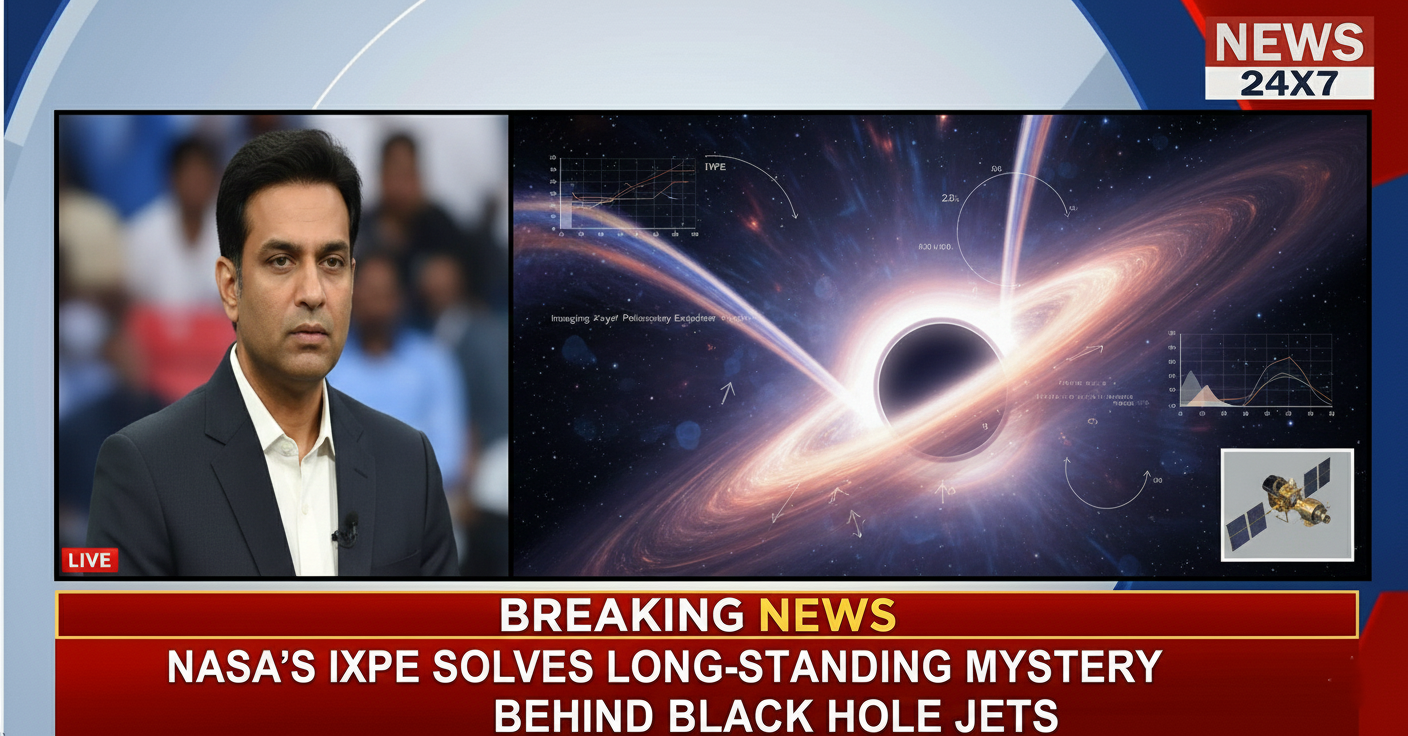
What Are Black Hole Jets?
Black hole jets are narrow streams of particles and energy that shoot out at near-light speed from the regions surrounding black holes. These jets can extend for thousands or even millions of light-years, influencing the evolution of entire galaxies.
For decades, scientists have debated how black holes — which themselves pull everything inward — can produce such powerful outward-flowing jets.
The Long-Standing Mystery
The central mystery revolved around the role of magnetic fields. Scientists suspected that twisted magnetic fields around black holes might be responsible for launching and guiding the jets, but there was no direct observational proof.
Traditional telescopes could observe the brightness and shape of jets but lacked the ability to study the direction and structure of magnetic fields in detail.
How IXPE Changed the Game
Launched by NASA to study X-ray polarization, IXPE is uniquely designed to measure the orientation of X-ray light emitted from extreme cosmic environments. By analyzing how X-rays are polarized, scientists can infer the structure and behavior of magnetic fields near black holes.
Using IXPE, researchers studied X-ray emissions from black hole jets and discovered a clear pattern in polarization that pointed to highly ordered magnetic fields.
Key Discovery: Helical Magnetic Fields
IXPE’s observations revealed that black hole jets are shaped and stabilized by spiral or helical magnetic fields. These twisted fields act like cosmic rails, guiding particles outward in a narrow, focused beam instead of allowing them to disperse.
This finding confirms long-standing theoretical models that proposed magnetic fields as the engine behind jet formation.
How Jets Are Launched
According to the new data, as matter spirals toward a black hole, it drags magnetic field lines along with it. These fields become twisted due to the black hole’s rotation, storing enormous amounts of energy.
That energy is then released in the form of jets, ejecting particles away from the black hole at extreme speeds while remaining tightly collimated.
Why This Matters
Understanding black hole jets is crucial because they play a major role in shaping galaxies. Jets can heat surrounding gas, regulate star formation, and even influence how galaxies grow over billions of years.
By confirming the magnetic nature of jet formation, scientists now have a clearer picture of how black holes interact with their cosmic environment.
A New Era of Black Hole Research
The success of IXPE demonstrates the power of X-ray polarimetry as a tool for studying extreme astrophysical phenomena. Scientists believe similar techniques could now be applied to study neutron stars, supernova remnants, and other high-energy cosmic events.
The findings also open the door for improved simulations and models that more accurately reflect real cosmic conditions.
What’s Next
Researchers plan to continue using IXPE to study different types of black holes and compare how jets behave across various environments. Future missions may build upon IXPE’s success with even more advanced instruments.
Each new observation brings humanity closer to understanding the most extreme objects in the universe.
Conclusion
NASA’s IXPE has finally provided direct evidence explaining how black holes launch and control their powerful jets, solving a mystery that has challenged scientists for decades. By revealing the role of twisted magnetic fields, the mission has reshaped our understanding of black holes and their influence on the cosmos.
The discovery stands as a reminder that even the darkest objects in the universe still have many secrets waiting to be uncovered.