


























“Mahatma Not From My Family, But…”: Priyanka Gandhi Leads ‘G Ram G’ Protest
Congress leader Priyanka Gandhi Vadra led a protest over the controversial “G Ram G” remark, delivering a sharp political message while urging restraint in the use of revered names for political attacks. Addressing party workers and supporters, Priyanka Gandhi said that Mahatma Gandhi did not belong to her family alone but to the entire nation, emphasising that his legacy must not be distorted or weaponised for political gain.
Her remarks came amid a growing political storm over the “G Ram G” controversy, which has triggered heated exchanges between the Congress and its rivals, with allegations of disrespect toward national and religious symbols dominating the debate.
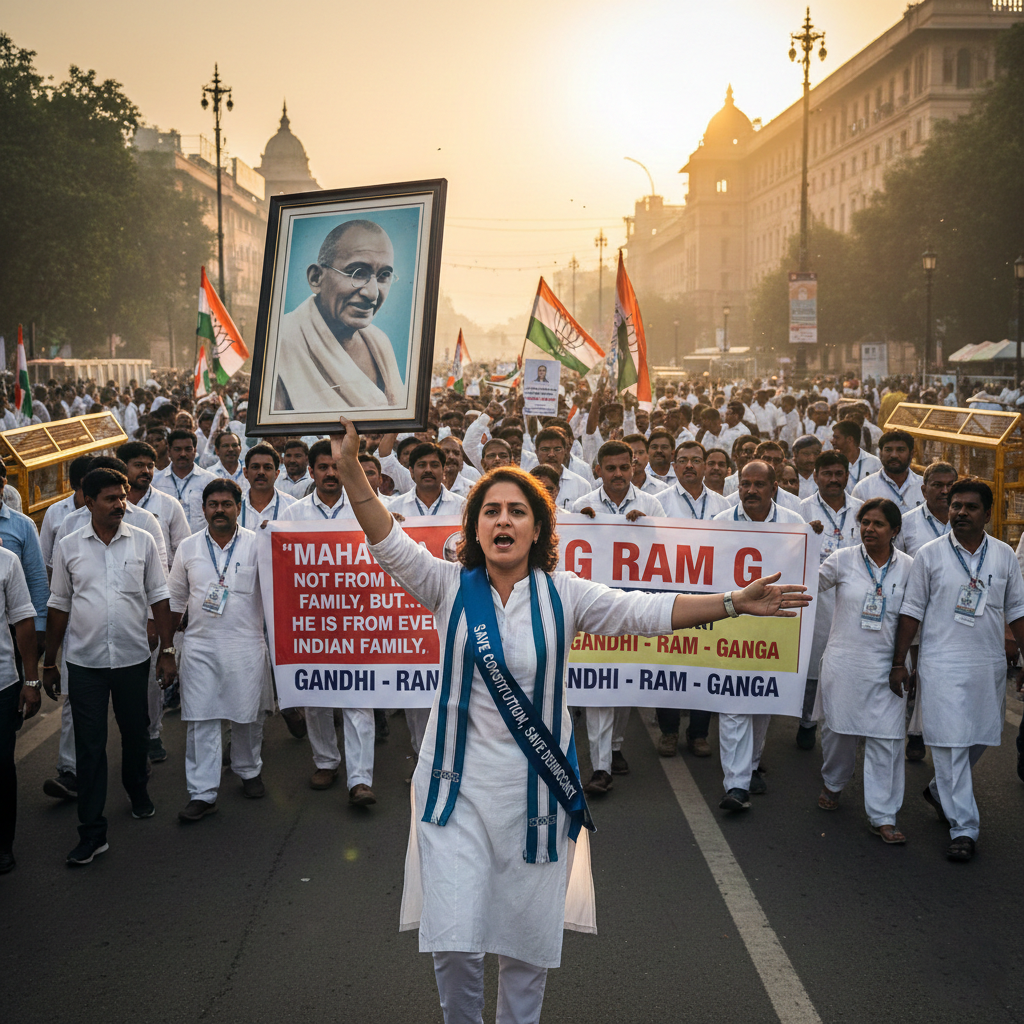
Priyanka Gandhi’s Message at the Protest
Speaking at the protest, Priyanka Gandhi sought to draw a distinction between political disagreement and respect for historical and moral icons. She stated that Mahatma Gandhi’s ideals of truth, non-violence, and harmony transcend party lines and family lineage.
“Mahatma Gandhi is not from my family alone, he belongs to the country,” she said, stressing that his name should inspire unity rather than be used to provoke division or score political points.
Her statement was met with applause from party supporters, many of whom carried placards and slogans calling for respectful political discourse.
Backdrop of the ‘G Ram G’ Row
The controversy erupted following political remarks and slogans linked to the phrase “G Ram G,” which critics alleged were being misused to target the Congress and question its respect for cultural and national values. The ruling party and its allies accused the Congress of insulting revered figures, while the opposition dismissed the allegations as politically motivated.
The row has since escalated into a broader debate on the use of symbolism, faith, and historical figures in political messaging.
Congress Pushes Back Against Allegations
At the protest, Congress leaders reiterated that the party respects all religions and national icons. Priyanka Gandhi accused political opponents of deliberately misinterpreting statements to divert attention from issues affecting ordinary citizens, such as unemployment, inflation, and social inequality.
She said the Congress would continue to stand for inclusive politics rooted in constitutional values, adding that attempts to polarise society through selective outrage would not succeed.
Call for Civility in Politics
Priyanka Gandhi appealed for civility and dignity in public discourse, urging leaders across parties to refrain from dragging revered names into political mudslinging. She said healthy democracy thrives on debate over policy and governance, not on controversy created through misrepresentation.
Political observers noted that her remarks were aimed at reclaiming moral ground amid an emotionally charged debate, while also reinforcing the Congress’s narrative of pluralism and unity.
Political Reactions and Public Response
The protest drew mixed reactions. Congress supporters hailed Priyanka Gandhi’s leadership and described her remarks as a reminder of shared national values. Critics, however, accused the party of attempting to deflect criticism through symbolism.
Analysts pointed out that the controversy reflects the increasingly emotive nature of political discourse, where historical figures and religious imagery often become central to electoral narratives.
Larger Implications
The episode has reignited discussion on how political parties invoke legacy and faith in contemporary politics. Experts warn that excessive politicisation of revered figures risks diluting their significance and deepening social divides.
They argue that leaders bear a responsibility to uphold respectful dialogue, especially in a diverse society where symbols carry deep emotional meaning.
Conclusion
By leading the ‘G Ram G’ protest and asserting that Mahatma Gandhi belongs to the entire nation, Priyanka Gandhi sought to frame the controversy as one of values rather than lineage or political rivalry. Her remarks underscored the Congress’s attempt to position itself as a defender of inclusive traditions amid an increasingly polarised political climate.