



































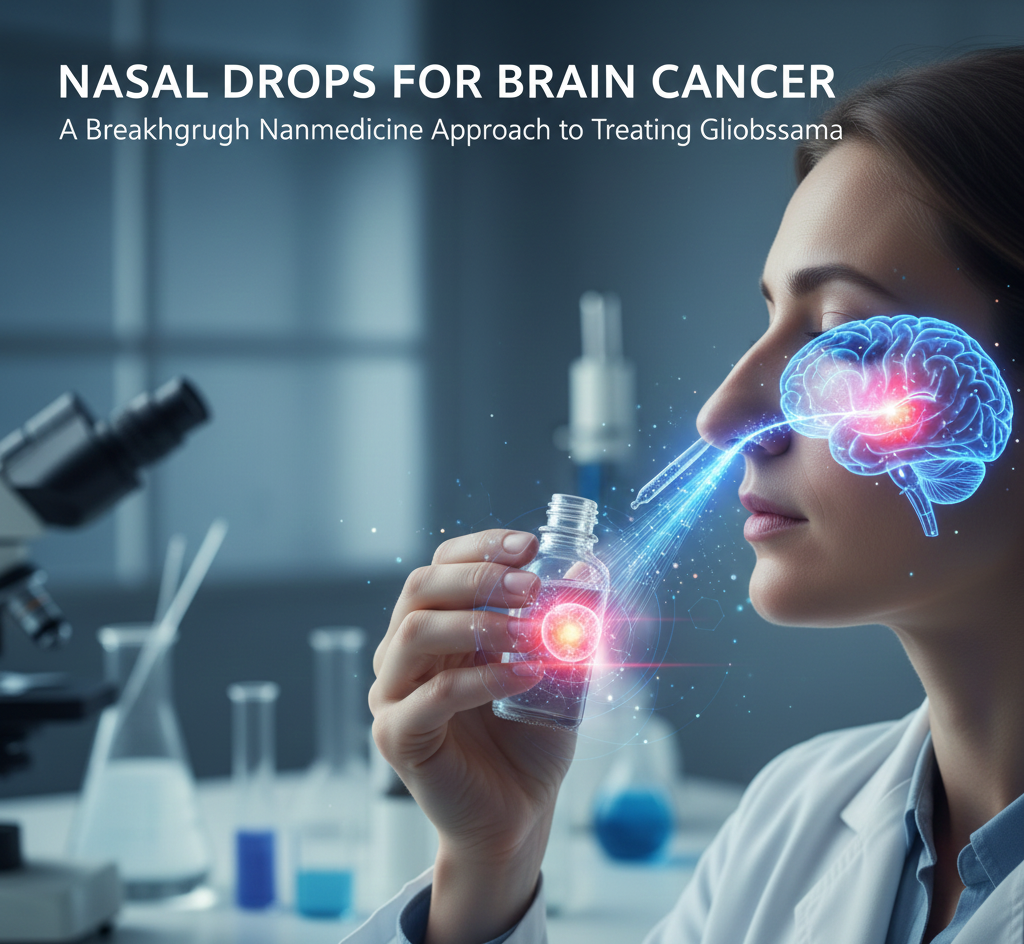
Nasal Drops for Brain Cancer: A Breakthrough Nanomedicine Approach to Treating Glioblastoma (2025)
Glioblastoma (GBM) remains one of the most aggressive and hardest-to-treat brain cancers in the world. Traditional treatments—surgery, chemotherapy, and radiotherapy—offer limited effectiveness because GBM cells spread rapidly and hide deep within brain tissue. But in 2025, scientists are focusing on a groundbreaking idea that is capturing global attention:
Can nasal drops deliver nanomedicine directly to the brain to treat glioblastoma?
This approach has the potential to transform brain cancer treatment by bypassing one of the biggest obstacles in medicine: the blood–brain barrier.
Why Glioblastoma Is So Hard to Treat
Glioblastoma is resistant to most drugs due to:
Rapid tumor growth
High recurrence rate
Infiltrative cancer cells that spread beyond surgical reach
A protective blood–brain barrier that blocks most medications
Even powerful chemotherapy drugs struggle to reach tumor sites in effective concentrations. This is where nanomedicine comes into the picture.
The Science Behind Nasal Nanomedicine Delivery
How can nasal drops reach the brain?
The nose has a direct pathway to the brain through:
The olfactory nerve
The trigeminal nerve
Unlike oral or intravenous drugs, nasal delivery can bypass the blood–brain barrier entirely. When combined with nanoscale drug carriers, the medicine can reach deeper areas of the brain where tumors hide.
Role of Nanoparticles
Nanoparticles used in research can:
Carry anti-cancer drugs in microscopic capsules
Target tumor cells more precisely
Release medicine slowly and steadily
Reduce damage to healthy cells
This method is being studied as a safer, more efficient way to deliver treatment directly to GBM tumors.
Potential Benefits of Nasal Nanomedicine Therapy
Researchers believe this approach could lead to several advantages:
1. Direct drug delivery to the tumor
Nasal pathways allow medicine to avoid the blood–brain barrier and reach brain tissue more effectively.
2. Lower doses, fewer side effects
Since the medicine doesn’t circulate through the entire body, patients may experience fewer toxic effects.
3. Better penetration into tumor regions
Nanoparticles can travel into complex tissue structures where traditional drugs fail.
4. Non-invasive and patient-friendly
A nasal spray or drops would be easier for patients to use compared to injections or infusions.
5. Better targeting
Some nanoparticle systems are designed to detect cancer cells and attach specifically to them, helping destroy tumor clusters more efficiently.
Where Research Stands in 2025
The nasal nanomedicine approach is promising but still under research. Studies in 2025 include:
Animal trials showing improved drug penetration
Nanoparticle-enhanced chemotherapy models
Experiments on reducing tumor recurrence
Investigations into combining nasal nanomedicine with immunotherapy
While early results look encouraging, large-scale human clinical trials are still required before this method becomes a standard treatment.
Challenges That Remain
Despite the excitement, several scientific hurdles still need solutions:
Ensuring nanoparticles are safe long-term
Controlling dosage accurately through nasal pathways
Designing particles that do not trigger immune reactions
Ensuring treatment reaches all tumor clusters
Conducting clinical trials on human glioblastoma patients
Scientists emphasize that while this approach is innovative, it must pass strict safety and efficacy tests.
The Future: A New Hope for GBM Patients
If ongoing research succeeds, nasal-drop nanomedicine could become one of the most important breakthroughs in brain cancer treatment. It represents:
A non-invasive therapy
A targeted approach
A promising method to bypass the blood–brain barrier
A potential way to improve survival rates
Glioblastoma is one of the toughest cancers to fight, but new technologies—especially nanomedicine delivered through the nose—may open the door to more effective therapies.