


































Increase in Government Schools With Low Student Enrolment Raises Concerns Across India – 2025 Analysis
India’s education landscape is undergoing a silent crisis. While the government continues to build schools and upgrade infrastructure, a rising number of government schools across the country are witnessing extremely low student enrolment. Many have fewer than 30 students; some have fewer than 10.
This growing trend in 2025 has triggered serious concerns regarding the future of public education, teacher deployment, and educational equity.
A Worrying Trend Across States
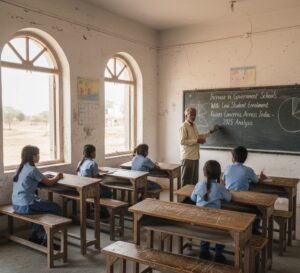
Several states — including Odisha, Himachal Pradesh, Uttarakhand, Madhya Pradesh, Rajasthan, and even parts of Maharashtra and Karnataka — are reporting a rapid decline in enrolment in government schools, especially in rural and remote areas.
Key observations from recent surveys and state-level reports:
Many primary schools have one teacher handling multiple classes.
Some schools have more staff members than students.
Students from rural families are increasingly shifting to private budget schools, even when they cost more.
In tribal and remote regions, migration and shrinking populations are contributing to the decline.
These indicators highlight a deep structural imbalance in India’s school distribution and demand.
Why Is Student Enrolment Dropping?
The reasons are multi-layered and differ across regions, but the pattern is consistent. The major factors include:
1. Rising Preference for Private Schools
Parents, even from low-income backgrounds, prefer low-fee private schools because they believe:
English-medium instruction
better discipline
higher accountability
improved learning outcomes
are more easily found there.
2. Population Decline in Rural Areas
Large-scale rural-to-urban migration is leaving many villages with only a handful of school-going children.
3. Multi-Grade Teaching in Government Schools
In many schools, one teacher teaches Classes 1 to 5 together. This leads to:
poor individual attention
limited learning progress
parent dissatisfaction
4. Perception Gap Despite Infrastructure Improvements
The government has improved buildings, toilets, midday meals, and digital tools — yet parents often equate quality with:
spoken English
strict academic culture
exam preparedness
teacher attendance
This perception gap continues to fuel the shift towards private schools.
5. Expansion of Schools Without Rationalization
Many government schools were opened years ago based on older population data. Over time, as demographics changed, school mapping was not updated.
Consequences of Low Enrolment
The decline in enrolment has far-reaching consequences:
1. Waste of Resources
Schools with fewer than 20–30 students still require:
teachers
infrastructure
funds for maintenance
midday meals
This leads to inefficient resource utilization.
2. Teacher Shortages in High-Demand Areas
Because some schools have surplus teachers with barely any students, urban and semi-urban government schools suffer teacher shortages.
3. Drop in Overall Learning Outcomes
When schools run with:
very few children
inadequate peer interaction
multi-class teaching
students’ learning levels stagnate or decline.
4. Difficulty in Implementing New NEP 2020 Reforms
Low-enrolment schools struggle to:
establish skill labs
adopt flexible grouping
introduce new subjects
integrate technology
This affects NEP implementation at the grassroots.
Government Response in 2025
States and the central government are taking steps such as:
1. School Merging / Consolidation
Many states are combining:
small, low-enrolment schools
with
bigger, better-equipped schools nearby
This is often called “school consolidation” or “rationalisation”.
2. Cluster-Based Schooling
Neighbouring schools are being organized into clusters to share:
teachers
resources
labs
sports facilities
3. Transport Support
States are offering:
free bus services
cycle distribution
transport allowances
to help students travel to consolidated schools.
4. Teacher Redistribution
Teachers from low-enrolment schools are being transferred to needy schools where class sizes are high.
5. Strengthening Foundational Learning
Government missions focusing on early-grade reading and numeracy aim to rebuild trust in public schools.
Concerns, Criticisms & Challenges
Despite reforms, several concerns remain:
1. Fear of School Closures
Parents worry that school consolidation may eventually lead to closures, affecting accessibility — especially for girls and students with disabilities.
2. Loss of Community Schools
Small village schools often act as community hubs. Merging them may weaken the village’s social ecosystem.
3. Transportation Gaps
In remote hilly and tribal regions, daily travel to consolidated schools is difficult and unsafe.
4. Quality Gap Not Addressed
Unless teaching quality improves, simply merging schools won’t rebuild trust in government education.
What Needs to Change?
Experts recommend:
Better teacher training focused on activity-based and multilingual learning.
Strict accountability for teacher attendance and performance.
English-medium options or bilingual models to meet parent aspirations.
Smart school mapping using real-time demographic data.
Strong communication to convince parents that government schools are improving.
Most importantly, public schools must become centres of academic excellence, not just free alternatives.