






























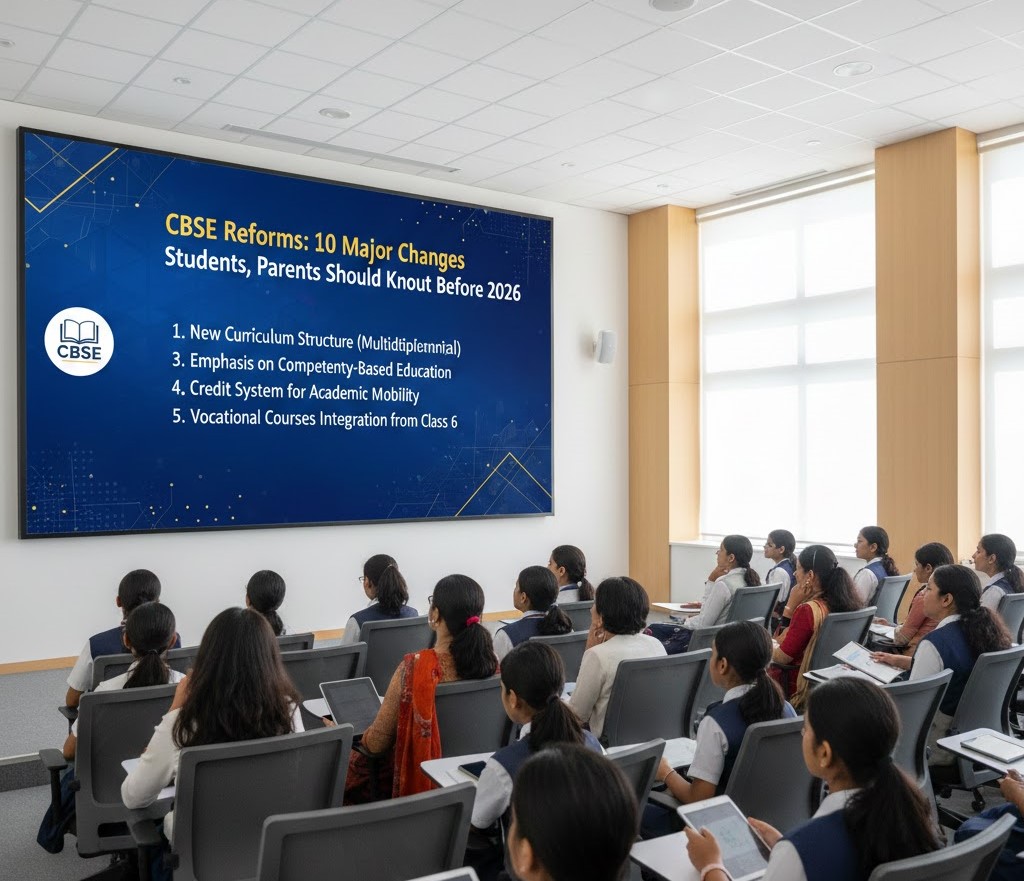
CBSE Reforms: 10 Major Changes Students & Parents Must Know Before 2026
The CBSE is entering one of its biggest transformation phases ever. Starting 2025 and continuing into 2026, the board is introducing new exam patterns, grading systems, skill-based subjects, flexible assessments, and many student-friendly reforms.
If you’re a student, parent, or educator — this guide breaks down everything you need to know in simple, engaging language.
1. More Competency-Based Questions — Less Rote Learning
CBSE is shifting away from memorization-heavy boards.
Expect more questions that test:
real understanding
reasoning
application of concepts
real-life problem-solving
This means mugging up textbooks won’t work anymore — understanding will matter more.
2. 40% Internal Assessment + 60% Board Exams
CBSE is increasing the weight of school assessments.
Your final score will now include:
40% from school-based tests, projects, and practicals
60% from board exams
This gives consistent performers an advantage and reduces one-day exam pressure.
3. New 9-Point Grading System
Both Class 10 and 12 will shift to a 9-point grade scale.
This helps colleges evaluate students more precisely and reduces unhealthy competition over decimal points.
4. More Skill-Based Subjects — Not Just Traditional Academics
CBSE is pushing for real-world skills. Students now have options in areas like:
Artificial Intelligence
Computer Applications
Information Technology
Design Thinking
Physical Activity Training
Electronics & Hardware
Transportation Systems
This prepares students for future careers rather than only focusing on theory.
5. Flexible Passing Rules for Class 10
A student who fails a core subject may use a passed skill-based subject as a replacement while calculating the result.
This gives students more chances to pass without repeating a year.
6. Syllabus Lightened for Better Understanding
CBSE has trimmed unnecessary topics and is focusing on essential concepts rather than bulky chapters.
The aim is:
less stress, more meaningful learning.
7. Two Board Exams a Year (From 2026)
Students may get a chance to take the Class 10 board exam twice a year.
This provides:
a second chance without losing a year
reduced exam anxiety
flexibility to improve scores
You can choose your best performance — just like competitive exams.
8. Stronger Exam Security & Attendance Rules
To improve fairness, CBSE is tightening exam protocols. Schools will follow stricter rules for:
practical exams
attendance (minimum 75% required)
documentation
internal assessments
Digital evaluation and transparent systems will ensure a fairer process.
9. Focus on Soft Skills & Holistic Growth
Along with academics, CBSE now emphasizes:
creativity
communication skills
collaboration
critical thinking
life skills
Students will do more projects, teamwork tasks, and real-life application activities.
10. Reduced Overall Exam Stress
The combined impact of these reforms means:
students no longer depend on one final exam
practical learning counts more
skill subjects offer backup
exam format is becoming more student-friendly
This is a huge shift toward a healthier school life.
What Students Should Do Now
Start focusing on understanding, not memorizing
Practice reasoning-based and application-based questions
Choose skill subjects wisely
Improve project work and internal assessments
Maintain consistent attendance
What Parents Should Know
Marks will now reflect year-long performance, not only final exams
Skill-based subjects can open new career paths
Students may attempt boards twice starting 2026
Pressure will gradually reduce as learning becomes more practical